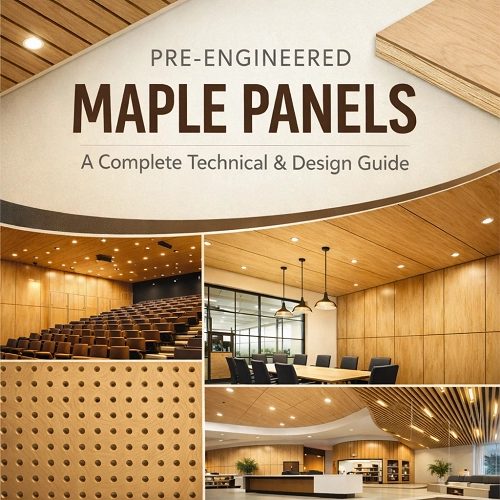
As architects and interior designers increasingly demand materials that fuse authentic wood character with dimensional consistency, pre-engineered maple panels have emerged as a leading solution — combining the warmth of solid maple with the structural reliability of precision-engineered cores.
Pre-engineered maple panels are factory-assembled wall and ceiling boards that integrate solid maple wood faces — produced through solid wood splicing — onto a dimensionally stable engineered substrate. Unlike raw timber boards, they arrive at the job site with surfaces already treated, dimensioned, and finished, dramatically reducing on-site labor time.
The distinguishing manufacturing step is steel-brush hand-finishing, a technique in which stiff steel bristles are drawn along the grain to open the wood pores, accentuate medullary rays, and create a low-sheen, tactile texture often described as a "water wave" or rippled effect. This treatment adds visual depth while simultaneously creating a surface that conceals minor scuffs over time — an important performance advantage in high-traffic commercial settings.
MOOSOO's flagship pre-engineered maple panel (model 6101PU) ships in a single, contractor-friendly sheet format. The table below summarises all key parameters:
| Parameter | Value / Detail |
|---|---|
| Product Code | 6101PU |
| Wood Species | Maple (Acer spp.) |
| Surface Colour / Style | Water Wave Solid Wood |
| Sheet Dimensions | 1,220 mm × 2,440 mm (approx. 4 ft × 8 ft) |
| Thickness | 3.6 mm |
| Surface Treatment | Steel-brush hand-finished |
| Construction Method | Solid wood splicing |
| Formaldehyde Standard | E0 (≤ 0.05 mg / m³ air) |
| Suitable Orientation | Vertical (walls) & Horizontal (ceilings) |
| Primary Markets | Residential & Commercial Interiors |
Table 1 — Core technical data for MOOSOO model 6101PU pre-engineered maple panel.
Maple (Acer saccharum and allied species) ranks among the hardest commercially available domestic hardwoods, typically scoring between 1,450 and 1,700 lbf on the Janka hardness scale. Its tight, uniform grain structure resists denting and abrading, making it ideal for surfaces that face regular contact. The pale, creamy heartwood also accepts pigmented oils and stains predictably — a critical quality-control advantage in pre-finished panel manufacturing.
The water wave solid wood coloration referenced in MOOSOO's specification refers to the natural quilted or rippled figure that occurs in certain maple logs, amplified by the steel-brush finishing process. This creates a panel that reads as visually dynamic without introducing the chaotic variation seen in heavily figured veneers.
The production of pre-engineered maple panels at MOOSOO's facility in Jiashan County, Zhejiang Province, follows a controlled multi-stage workflow:
| Criteria | Pre-Engineered Maple | Raw Solid Wood Boards | MDF with Veneer | High-Pressure Laminate (HPL) |
|---|---|---|---|---|
| Dimensional Stability | High (engineered core) | Medium (seasonal movement) | High | Very High |
| Authentic Wood Feel | ✔ Solid wood face | ✔ Full solid | Partial (thin veneer) | ✗ Synthetic surface |
| On-site Labour | Low (pre-finished) | High (sand, stain, finish) | Low–Medium | Low |
| Emission Standard | E0 | N/A (untreated) | E1–E0 (varies) | E1 typical |
| Surface Texturing | Steel-brushed grain | Machine or hand-planed | Flat (veneer grain only) | Embossed print |
| Typical Thickness | 3.6 mm | 18–25 mm | 12–18 mm | 6–25 mm |
| Weight per Sheet | Light (low profile) | Heavy | Medium–Heavy | Medium |
Table 2 — Performance comparison across common interior panel types. Data reflects typical industry benchmarks.
Correct installation is essential to preserving the dimensional and visual integrity of pre-engineered maple panels. The following guidelines are based on MOOSOO's official user guide:
| Sector | Typical Use | Key Benefit |
|---|---|---|
| Residential | Feature walls, living room cladding, bedroom headboard panels | Warmth, biophilic design, quick installation |
| Hospitality | Hotel lobbies, restaurant interiors, reception backdrops | Premium aesthetics, durable surface |
| Commercial Office | Executive suites, boardroom walls, elevator lobbies | Professional finish, E0 air quality compliance |
| Retail | Display backdrops, fitting rooms, branded environments | Lightweight, easily reconfigured |
| Cabinetry & Furniture | Shelving faces, cabinet door overlays, decorative panels | Solid wood feel, machining flexibility |
| Healthcare & Education | Acoustic wall treatments, breakout spaces | Low-emission E0 rating, easy-clean textured surface |
Table 3 — Recommended application sectors and associated performance advantages.
Routine care for pre-engineered maple panels is straightforward. Day-to-day cleaning requires only a dry or lightly dampened microfibre cloth. The steel-brushed grooves should be cleared with a soft-bristle brush to prevent dust accumulation. Prolonged direct exposure to moisture should be avoided; if panels are used near kitchens or bathrooms, a compatible clear sealant coat applied to edges and joints is recommended.
Periodic inspection of adhesive bonds and mechanical fixings — particularly in environments with large seasonal humidity swings — will catch any incipient joint movement before it becomes visually apparent. Because the face layer is solid maple (rather than a thin veneer), minor surface scratches can be lightly sanded and re-oiled in place, a significant advantage over laminate or paper-foil alternatives.
The E0 formaldehyde emission standard is the most immediately visible environmental credential of MOOSOO's panels, but the solid wood splicing technique also contributes to material efficiency: narrow offcuts that would otherwise be waste are edge-joined into full-width faces, increasing yield from each log by an estimated 15–25% compared to plain-sawn wide boards.
Designers specifying for LEED, BREEAM, or WELL certification should verify current third-party test certificates directly with the manufacturer, as environmental documentation requirements vary by certification body and regional jurisdiction.
The 6101PU pre-engineered maple panel sits within MOOSOO's broader Natural Series, which spans multiple timber species and surface treatments. Adjacent products relevant to specification teams include:
The full catalogue — including the Art Series and Technology Series — is available at woodveneermanufacturer.com.
Zhejiang Heyong Home Furnishing Intelligent Manufacturing Co., Ltd. operates from No. 129 Jinxiu Avenue, Yaozhuang Town, Jiashan County, Jiaxing City, Zhejiang Province — China's premier furniture manufacturing corridor.
Phone: 0086 13957350809
Email: sales@moosoo.com.cn
Website: woodveneermanufacturer.com
Pre-engineered maple panels represent a mature convergence of traditional woodworking craft and modern manufacturing precision. The steel-brush surface treatment, solid wood splicing construction, and E0 emission compliance position them as a specification-grade material suitable for the most demanding residential and commercial interiors. For procurement teams and designers seeking wholesale supply, MOOSOO's 6101PU panel offers a well-documented, factory-consistent solution backed by a manufacturer with broad species and surface-treatment capabilities across its Natural, Art, and Technology series.