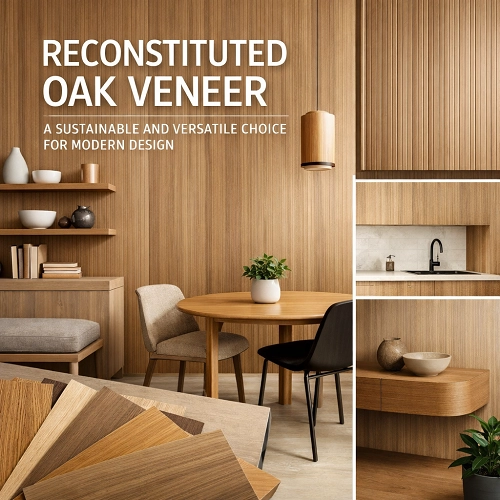
In the world of interior design and furniture manufacturing, wood veneers have long been valued for their ability to combine natural beauty with practical efficiency. Among the various options available today, reconstituted oak veneer has gained increasing popularity for its consistent appearance, sustainability, and cost-effectiveness. By combining natural wood fibers with advanced manufacturing techniques, this material offers designers and manufacturers the elegant look of oak while addressing many limitations of traditional solid wood or natural veneers.
Reconstituted oak veneer, sometimes called engineered veneer or recomposed veneer, is a man-made wood veneer created by processing fast-growing wood species and reassembling them to mimic the appearance of natural oak grain. Instead of slicing veneer directly from an oak log, manufacturers use a process that reconstructs the wood structure, allowing them to replicate the texture, color, and grain patterns of oak with remarkable consistency.
The result is a veneer that closely resembles real oak but offers improved uniformity and sustainability. Because the grain pattern can be carefully controlled during production, designers can achieve a predictable and repeatable aesthetic across large surfaces.
The production of reconstituted oak veneer involves several carefully controlled steps:
Manufacturers typically use fast-growing and sustainable wood species such as poplar, basswood, or obeche as the base material.
The logs are peeled into thin sheets and dyed to achieve the desired oak-like color tone. Dyeing ensures that the color penetrates the wood fibers evenly.
The dyed sheets are stacked and glued together in a specific orientation designed to simulate natural oak grain patterns.
The stacked sheets are compressed into large blocks. The arrangement of the sheets determines the final grain appearance.
The blocks are then sliced into thin veneers, revealing the reconstructed oak grain pattern.
This engineered process allows manufacturers to create highly consistent veneers that replicate traditional oak aesthetics while minimizing waste.
One of the most significant benefits of reconstituted oak veneer is its uniform grain pattern and color. Natural oak varies from log to log, while engineered veneer ensures consistency across large projects such as wall panels or furniture series.
Because it uses fast-growing wood species, reconstituted veneer reduces pressure on slow-growing hardwood forests. It also maximizes material efficiency by using nearly the entire log.
Reconstituted oak veneer is generally more affordable than natural oak veneer or solid oak, making it a practical solution for large-scale commercial and residential projects.
Manufacturers can create a wide range of grain patterns, colors, and textures. This flexibility allows designers to match specific visual styles, from classic oak to more contemporary interpretations.
Natural wood often contains knots, cracks, and irregular grain patterns. Engineered veneer minimizes these imperfections, resulting in a smoother and more predictable surface.
Reconstituted oak veneer is widely used in both residential and commercial environments. Some of the most common applications include:
Furniture Manufacturing
Cabinets, desks, wardrobes, and tables frequently incorporate reconstituted oak veneer due to its stable appearance and cost advantages.
Interior Wall Panels
Architects often use engineered oak veneer panels to create warm and natural interior spaces in offices, hotels, and residential buildings.
Doors and Decorative Surfaces
Interior doors, partitions, and decorative panels benefit from the veneer’s elegant oak look without the expense of solid hardwood.
Retail and Hospitality Design
Hotels, restaurants, and retail stores frequently use reconstituted veneers for their ability to maintain a consistent aesthetic across large areas.
While both materials share a similar appearance, they differ in several key aspects:
| Feature | Natural Oak Veneer | Reconstituted Oak Veneer |
| Grain Pattern | Unique and irregular | Uniform and controlled |
| Sustainability | Limited by oak resources | Uses fast-growing species |
| Cost | Higher | More affordable |
| Defects | Possible knots and variations | Minimal defects |
| Consistency | Hard to match across panels | Highly consistent |
For projects requiring natural uniqueness, traditional oak veneer may still be preferred. However, for large-scale installations requiring visual consistency, reconstituted veneer is often the better choice.
Sustainability is a major driver behind the growing adoption of reconstituted wood veneers. By utilizing rapidly renewable wood species and improving raw material efficiency, manufacturers can significantly reduce the environmental impact associated with hardwood harvesting.
In addition, the controlled production process reduces waste and allows manufacturers to optimize wood utilization. Many producers also follow certified forestry practices and environmentally responsible manufacturing standards.
As environmental awareness and design innovation continue to grow, reconstituted oak veneer is expected to become even more widely used. Advances in technology are enabling more realistic grain patterns, improved durability, and enhanced finishing options.
Architects and designers are increasingly exploring engineered veneers as a way to combine aesthetic appeal with sustainable materials, making them a key component of modern interior design strategies.
Reconstituted oak veneer represents a successful blend of natural beauty, modern technology, and sustainable resource management. By recreating the visual appeal of oak while offering improved consistency and efficiency, it provides a practical solution for contemporary furniture production and architectural design.
Whether used in furniture, wall panels, or interior finishes, reconstituted oak veneer offers designers the warmth and elegance of oak with the advantages of engineered performance. As the demand for sustainable and cost-effective materials continues to rise, this innovative veneer is poised to play an increasingly important role in the future of interior design and wood manufacturing.