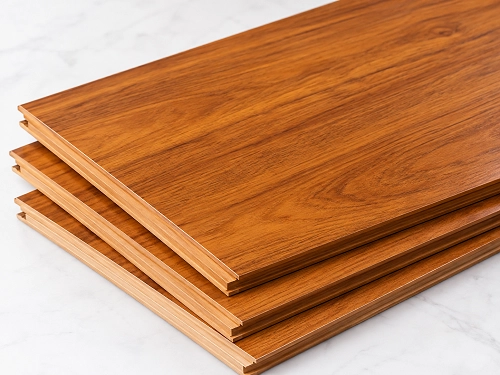


Key Takeaways
- A prefinished engineered teak panel pairs a real or reconstituted teak-look face with a stable substrate, and the finish is applied in the factory rather than on site.
- "KD" is used in two senses in the timber and furniture trades (knock-down and kiln-dried). Confirm which one a supplier means before you compare quotes.
- The product page for this panel does not publish detailed specifications. Request thickness, core, face, adhesive emission class and finish data in writing before you commit.
- Most panel failures come from moisture, edge exposure and poor acclimatisation. They do not come from the veneer itself.
What the Manufacturer Says About This Product
The KD Prefinished Teak Panels page lists the product under the company's Technology Series. The company's positioning for its engineered wood veneer is consistent quality, durability and a clean finish for interiors, furniture and architectural elements. Neighbouring products in the same series include the Engineered Oak KD Panel and the Faux Walnut Veneer, which suggests a family of panels built around the same prefinished approach in different species looks.
The manufacturer is based in Jiashan County, Jiaxing City, Zhejiang Province, China. Beyond the Technology Series, its catalogue is divided into the Natural Series and the Art Series. For manufacturing background, see the Company Profile and the Produce page.
Decoding "KD": Two Meanings, Two Different Buying Decisions
The product page does not define the abbreviation, so a careful buyer should ask. In practice there are two common readings:
- Knock-down: panels supplied as flat components, cut and finished at the factory, then assembled or installed at the destination. This lowers freight volume and breakage risk and suits furniture programmes and modular wall systems. The questions that matter are dimensional tolerance, edge treatment and the fixing method.
- Kiln-dried: wood dried in a controlled kiln to a target moisture content before processing. This matters because dimensional stability depends on moisture content. The questions that matter are the target moisture content at pressing and how it is verified.
The two are not mutually exclusive. A knock-down panel can be made from kiln-dried components. Ask the supplier to state the meaning in the quotation so there is no ambiguity in the contract.
Why Teak, and Why Engineered?
Teak (Tectona grandis) is valued for its warm golden-brown colour, straight to wavy grain and natural oil content. According to the Wood Database species profile for teak, it is a medium-density hardwood with good dimensional stability, which is part of why it has such a long history in furniture and joinery.
Solid teak has practical drawbacks in interior projects: high cost, colour variation between boards, weight, and supply constraints on quality material. An engineered panel addresses several of these:
- Yield: a thin face layer covers a large surface area, so a limited amount of teak goes further.
- Stability: a balanced, cross-banded or engineered substrate resists the seasonal movement that solid wide boards show.
- Consistency: sorting and matching of faces in a factory gives more uniform colour across a project than site-selected solid boards.
- Weight and handling: panels are lighter than solid timber of the same area, which helps with wall cladding and large furniture components.
The Value of Prefinishing
Finishing in a controlled factory environment, rather than on a job site, changes the project in several ways:
- Repeatability: spray or roller application, flash-off and curing happen under controlled temperature and humidity, so gloss and colour are easier to keep consistent between batches.
- Schedule: no sanding, staining or lacquering on site means shorter installation and no extended drying period.
- Site air quality: solvent-borne finishing is moved out of occupied or near-complete buildings.
- Trade-off: repairs after installation are harder. Keep a small overage and a record of the finish batch for future matching.
Technical Considerations Before You Specify
1. Moisture content and acclimatisation
Wood gains and loses moisture until it reaches equilibrium with the surrounding air. The U.S. Forest Products Laboratory's Wood Handbook: Wood as an Engineering Material explains this equilibrium moisture content principle and its effect on dimensional change. For interiors, the practical lesson is to store panels flat in the installation environment for a period before fixing, and to avoid installing them in a building where the HVAC system is not yet running.
2. Substrate and construction
The substrate determines flatness, screw-holding, edge quality and weight. Common options are plywood, MDF or particleboard and engineered lumber cores. Ask whether the construction is balanced (a back veneer or backer of comparable thickness) because an unbalanced panel is more likely to warp when humidity changes.
3. Face material: natural veneer or reconstituted?
"Engineered wood veneer" can mean sliced natural teak, or reconstituted veneer made from fast-growing species and dyed or patterned to resemble teak. Both are legitimate products, but they differ in price, grain variation and sustainability profile. The company's page does not specify which applies, so ask for the face description and a physical sample. Do not accept a rendering as a substitute.
4. Adhesive emissions and regulatory compliance
Panels sold into regulated markets need documented formaldehyde emission performance. In the United States, composite wood products are subject to the EPA's formaldehyde emission standards for composite wood products under TSCA Title VI. In Europe, buyers commonly refer to the emission classes in EN 13986 and the test method in EN 717-1. Ask for the applicable test report and certificate for the exact panel construction you are buying. The product page does not list a certificate, so treat compliance as unconfirmed until you hold the documents.
5. Surface finish performance
A "flawless finish" is a marketing phrase, not a specification. For commercial or high-traffic use, request data on gloss level, abrasion and scratch resistance, resistance to household chemicals and light fastness. Teak-look finishes are often chosen for a warm tone, so colour shift under UV exposure deserves particular attention in rooms with strong daylight.
6. Edges, cutting and fixing
The cut edge is where moisture enters and where chipping shows. Use sharp, fine-tooth carbide blades, support the panel on the finished face side as the manufacturer recommends, and seal or edge-band every cut edge. Pre-drill for screws near edges.
Comparison: Teak Options at a Glance
The table below is a general comparison of material categories, not a set of verified specifications for any one product. Actual performance varies by manufacturer and construction.
| Attribute | Solid teak | Prefinished engineered teak panel | Teak-pattern laminate or foil |
|---|---|---|---|
| Surface | Real teak throughout | Teak or teak-look veneer face on a substrate | Printed pattern, no real wood |
| Material cost | Highest | Moderate | Lowest |
| Colour consistency | Varies board to board | Controlled by sorting and factory finishing | Very uniform |
| Dimensional movement | Present, managed by design | Reduced by engineered construction | Depends on substrate |
| Site finishing needed | Usually yes | No (prefinished) | No |
| Repairability | Can be sanded and refinished | Limited by veneer thickness; touch-up possible | Generally not repairable |
| Best suited to | Premium furniture, solid joinery | Wall panels, cabinetry, furniture carcasses, fit-out programmes | Budget-driven, high-wear surfaces |
Specification Checklist: What to Request From the Supplier
Because the product page does not list technical data, use the table below as a request sheet. A reliable supplier should be able to complete every row.
| Item | What to ask | Why it matters |
|---|---|---|
| Meaning of "KD" | Knock-down, kiln-dried, or both? | Determines packaging, assembly and moisture expectations |
| Face material | Sliced natural teak or reconstituted teak-look veneer? | Affects appearance, price and sustainability claims |
| Core and thickness | Core type, total thickness, tolerance, and whether the panel is balanced | Controls flatness, strength and fixing method |
| Panel sizes | Standard and custom dimensions, minimum order quantity | Impacts cutting waste and layout |
| Finish system | Coating type, gloss level, colour reference | Determines appearance, maintenance and touch-up approach |
| Emission compliance | Test reports for formaldehyde class applicable to your market | Required for lawful sale in several regions |
| Moisture content | Target at shipping and how it is measured | Predicts movement after installation |
| Timber legality | Documentation of species origin and chain of custody | Supports due diligence under timber-import rules |
| Samples and batch matching | Physical samples, and a policy for matching colour across production runs | Prevents visible mismatch on large projects |
Where These Panels Fit Best
- Interior wall cladding in hotels, offices and residences where a warm teak tone is wanted over large areas.
- Furniture and cabinetry components for manufacturers who need a stable, consistent face for repeat production.
- Fit-out programmes with tight installation schedules, where eliminating on-site finishing is valuable.
- Not recommended: permanent outdoor exposure or continuously wet areas, unless the manufacturer explicitly rates the panel for that use. Solid teak's reputation for outdoor durability does not automatically transfer to a veneered interior panel.
For visual references on how veneer products are used in finished spaces, the manufacturer maintains Case and Style pages.
Installation and Care: Practical Notes
- Inspect panels on delivery under good light, and check for transit damage and shade differences before opening every pack.
- Store flat, off the floor and supported evenly, in the building where they will be installed.
- Lay out panels in sequence from the same batch so that grain and tone flow across adjacent pieces.
- Seal cut edges and keep fixings and adhesives compatible with the finish. Follow the manufacturer's written guidance where it exists.
- For cleaning, use a soft cloth and mild, non-abrasive cleaner. Avoid soaking and avoid solvents that can soften coatings.
Sourcing and Sustainability Questions Worth Asking
Teak is widely grown in plantations, but plantation origin, legality and chain of custody still need to be documented. Buyers in the EU, the US and elsewhere face due-diligence obligations on imported timber products, so ask for species and origin documentation and for any third-party certification, such as FSC or PEFC, that applies to the actual product. The product page does not state any certification, so it should be treated as unconfirmed until documents are supplied.
Frequently Asked Questions
Are prefinished engineered teak panels real wood?
It depends on the product. Some use sliced natural teak on the face; others use reconstituted veneer designed to look like teak. Ask the supplier to state which one applies.
Can the finish be repaired on site?
Minor marks can often be touched up with a compatible repair product, but sanding back a thin veneer is risky. Keep spare panels and ask the supplier for touch-up guidance.
How do I get samples or a quotation?
Use the contact form on the product page or the Contact page. The company lists the email address sales@moosoo.com.cn and the phone number 0086 13957350809. Include your target application, quantity, destination country and the checklist items from Table 2.