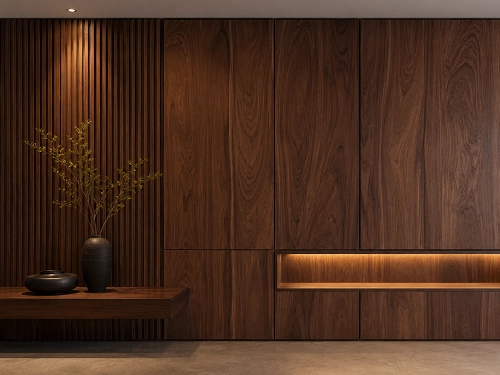


Few materials carry the same weight of craftsmanship and prestige as black walnut. Its deep chocolate tones, subtle purple undertones, and flowing grain have made it a first choice for architects, cabinet makers, and interior designers for generations. Today, Black Walnut Veneer Panels allow that same luxury to be applied at scale, with far greater consistency, sustainability, and cost efficiency than solid walnut lumber. In this article, we take a deep technical look at what black walnut veneer panels are, how they are manufactured, where they perform best, and what specifications matter most when sourcing them for a commercial or residential project.
What Are Black Walnut Veneer Panels?
Black Walnut Veneer Panels are engineered wood panels faced with a thin layer of natural or reconstituted walnut veneer, bonded to a stable substrate such as MDF, plywood, or particleboard. This construction method preserves the authentic look and tactile warmth of solid walnut while significantly reducing material waste, panel weight, and the risk of warping that is common with solid hardwood boards. Manufacturers such as MOOSOO's Black Walnut Veneer Panels combine a walnut-faced surface with a Steel Brushed Solid Wood texture finish, giving the panel a tactile, dimensional grain that reads as genuine solid timber under both natural and artificial lighting.
Standard Technical Specifications
Consistency in dimensions and environmental compliance is critical when specifying veneer panels for large-scale commercial fit-outs. Below is a typical specification table for standard black walnut veneer panels currently produced for architectural and furniture applications.
| Specification | Detail |
|---|---|
| Wood Species | American / Natural Black Walnut |
| Panel Type | Painted Veneer Panel |
| Surface Finish | Steel Brushed Solid Wood Texture |
| Standard Dimensions | 1220mm (W) x 2440mm (L) x 3.6mm (T) |
| Environmental Grade | E0 (Low Formaldehyde Emission) |
| Typical Substrate | MDF / Plywood core |
| Recommended Use | Indoor cabinetry, wall paneling, furniture |
Full technical documentation and downloadable specification sheets for this product line are available on the manufacturer's official product page: Black Walnut Veneer Panels — Product Instructions.
Why Manufacturers Use the E0 Standard
The E0 formaldehyde emission grade is one of the strictest classifications in the panel industry, generally corresponding to emission levels below 0.5 mg/L. For veneer panels intended for hospitality, healthcare, education, and residential interiors, this rating matters because it directly affects indoor air quality. Reputable manufacturers pair E0-grade substrates with FSC-certified veneer sourcing to ensure the finished panel is both safe for occupants and traceable back to responsibly managed forests.
Manufacturing Process Overview
Producing a high-quality black walnut veneer panel involves several precision-controlled stages. Understanding this process helps buyers evaluate panel quality before purchase.
| Stage | Process Description |
|---|---|
| 1. Log Selection & Slicing | Walnut logs are sliced into thin veneer leaves, selected for grain consistency and color depth. |
| 2. Drying & Grading | Veneer sheets are dried to a controlled moisture content and graded by figure and tone. |
| 3. Splicing & Matching | Sheets are book-matched or slip-matched to form a continuous grain pattern across the panel face. |
| 4. Substrate Bonding | The veneer face is pressed onto an MDF or plywood substrate using E0-grade adhesive under controlled heat and pressure. |
| 5. Surface Texturing | A steel-brush finishing pass opens the grain, producing a tactile, dimensional surface texture. |
| 6. Sealing & QC | Panels are sealed, inspected for defects, and cut to standard sheet dimensions. |
Installation Best Practices
Correct handling and installation preserve both the appearance and structural performance of veneer panels. Based on manufacturer installation guidelines, the following practices are recommended:
- Acclimatization: Allow panels to rest in the installation environment for at least 48 hours before fixing, so they equalize to ambient temperature and humidity.
- Cutting technique: Always cut with the decorative face down and use sharp, fine-tooth blades to prevent veneer chipping.
- Substrate preparation: The mounting surface must be dry, level, and free of dust, oil, or residue before adhesive application.
- Adhesive compatibility: Test the chosen veneer adhesive on a sample area first, since compatibility can vary between substrate types.
- Fastening: Where mechanical fixing is required, use thin-panel-rated nails or screws and avoid over-tightening, which can telegraph through the veneer face.
Where Black Walnut Veneer Panels Are Used
The versatility of walnut veneer panels makes them suitable across a wide range of project types, from hospitality lobbies to private residences.
| Application | Benefit |
|---|---|
| Wall Cladding | Adds texture, warmth, and acoustic softening to feature walls |
| Cabinetry & Furniture | Consistent grain matching for doors, tabletops, and custom furniture |
| Ceiling Panels | Enhances acoustic performance while adding visual depth overhead |
| Retail Displays | Premium backdrop material for luxury brand environments |
| Office Interiors | Refined finish for partitions, reception counters, and desking systems |
These applications align closely with real project deployments referenced in the manufacturer's Case Studies section, which documents completed hospitality and commercial interiors using their veneer panel ranges, and their broader Natural Series product line.
Maintenance and Longevity
Painted veneer surfaces are relatively low-maintenance but do require some care to preserve their finish over time:
- Wipe with a soft dry cloth or slightly damp microfiber cloth; avoid abrasive cleaners and solvents.
- Treat stains with a mild soap solution, testing on an inconspicuous area first.
- Keep panels away from prolonged moisture exposure and use only in well-ventilated indoor spaces.
- Limit direct, prolonged sunlight exposure to reduce the risk of color fading over time.
- Avoid dragging sharp or heavy objects across the surface to prevent scratching.
Storage and Handling Before Installation
Improper storage is one of the most common causes of panel warping before a project even reaches installation. Panels should be stored flat, fully supported, in a dry and shaded area, maintained at stable room temperature and moderate humidity. Stacking heights should follow manufacturer recommendations to avoid bending or edge damage during transport and staging.
Choosing a Reliable Manufacturer
Because veneer panels are a visible, long-term architectural finish, sourcing from an established and certified manufacturer significantly reduces project risk. Zhejiang Heyong Home Furnishing Intelligent Manufacturing Co., Ltd., operating under the MOOSOO brand, is one such example — a Chinese manufacturer with over two decades of production history, FSC forest certification, ISO system certification, and E0 environmental compliance across its veneer panel lines. Their production facility spans 100,000 square meters with a daily output capacity of roughly 50,000 square meters, supplying architectural and hospitality projects internationally. Readers can review their full manufacturing capabilities on the Company Profile page and production details on the Produce page.
Final Thoughts
Black Walnut Veneer Panels remain one of the most reliable ways to bring the richness of solid walnut into large-scale interior projects without the cost, weight, and sustainability concerns of solid lumber. When specifying panels, pay close attention to environmental grade (E0 or better), substrate quality, surface finish type, and manufacturer certifications. For architects and buyers researching current product specifications, the manufacturer's official listing remains the most reliable reference: https://www.woodveneermanufacturer.com/black-walnut-veneer-panels.html.