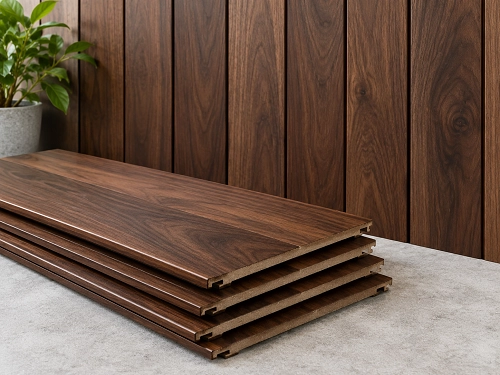
Black walnut is one of the few timbers that architects and homeowners request by colour alone. Its chocolate-brown heartwood, softened by purple-grey and golden streaks, gives a wall depth that paint and printed surfaces struggle to copy. It is also a timber with quirks, and the difference between a walnut wall that looks refined and one that looks patchy usually comes down to decisions made before installation.
MOOSOO is the brand of Zhejiang Heyong Home Furnishing Intelligent Manufacturing Co., Ltd., a wood veneer and wood panel manufacturer based at No. 129 Jinxiu Avenue, Yaozhuang Town, Jiashan County, Jiaxing City, Zhejiang Province, China. You can read more on our company profile and production overview pages. The timber properties below come from published sources listed at the end. Where a figure depends on a specific product batch, we say so rather than guess, and we recommend confirming it against the technical data sheet before ordering.
A cladding panel is a decorative wall or ceiling covering that is fixed over a structural surface. Our black walnut range (product code 6881DN) is presented as precision-milled panels for walls, ceilings and feature facades, with rich chocolate tones and subtle grain variation. It sits in our Natural Series, which is built around genuine hardwood surfaces rather than printed imitations.
If you need the walnut look with tighter colour and grain repeatability across a large project, our Technology Series offers Engineered Walnut Veneer and Reconstituted Walnut Veneer. These are a different product category with different behaviour, and the choice between natural and engineered walnut is covered below.
| Item | Detail |
|---|---|
| Product | Black Walnut Cladding Panels, code 6881DN |
| Series | Natural Series |
| Appearance | Chocolate tones with subtle grain variation |
| Manufacturing | Precision-milled for consistent sizing |
| Typical uses | Walls, ceilings, feature facades in residential and commercial projects |
| Thickness, dimensions, finish, MOQ | Project-specific; request the data sheet |
Black walnut (Juglans nigra) is a medium-density hardwood. It is softer than oak and maple, which is a benefit for cutting and profiling but means the surface will mark more easily in busy areas. It is also known for good dimensional stability once dry, which is one reason it has a long history in cabinetry and gunstocks.
| Species | Janka hardness (lbf, approx.) | Air-dry density (kg/m³, approx.) | Character |
|---|---|---|---|
| Black walnut | 1,010 | about 610 | Deep brown, straight to wavy grain, warm and formal |
| White oak | 1,360 | about 750 | Light to mid-tone, prominent grain, harder wearing |
| Hard maple | 1,450 | about 705 | Pale and fine-textured, very hard |
| Cherry | 950 | about 580 | Reddish, darkens noticeably with light exposure |
Figures are rounded and vary by tree and moisture content. Sources:and.
Hardness matters less on a wall than on a floor, so walnut's lower Janka value is rarely a concern for cladding. Colour behaviour matters more, and it is where most disappointments start.
A walnut log has dark heartwood surrounded by pale cream sapwood. Panels can contain either, and how a supplier handles the difference directly affects the finished wall. Two points are worth raising with any supplier:
Wood swells and shrinks with humidity, mostly across the grain. Using the Wood Handbook's tangential shrinkage figure for black walnut (about 7.8% from green to oven-dry), the movement works out to roughly 0.27% of the panel width for every 1 percentage point change in moisture content. This is our own calculation from published data, so treat it as an estimate for flat-sawn material.
For a 140 mm wide panel that gains or loses 3 points of moisture content across the seasons, the width changes by about 1.1 mm. That is small on one panel but adds up across a long run, which is why expansion gaps and reveal details are not optional on large walls.
There is no universally better option. The right answer depends on the size of the project and how much natural variation the client will accept.
| Consideration | Natural black walnut (Natural Series) | Engineered walnut (Technology Series) |
|---|---|---|
| Grain and colour | Unique to each panel, with visible natural variation | Designed for repeatable, consistent appearance |
| Best suited to | Feature walls, residences, projects that value authenticity | Large uniform runs such as hotel corridors and multi-room fit-outs |
| Tolerance for variation | Client must accept it | Low variation expected |
| Sample approval | Approve a range of samples, not a single piece | A single approved sample is a closer guide |
For decorative alternatives with dyed or brushed effects, see our Art Series. If you are weighing walnut against a lighter species for the same project, compare with White Oak Wood Planks or Hand-Scraped White Oak Boards.
Black walnut heartwood has good natural decay resistance for a temperate hardwood. That does not make it a low-maintenance exterior facade material. Uncoated walnut exposed to sun and rain will grey and weather, and end grain and joints are vulnerable to moisture. Our recommendation:
Fire requirements for wall and ceiling linings vary by country, building type and escape route, so check local regulations early. In Europe, solid wood panelling and cladding is covered by EN 14915, and reaction-to-fire is classified under EN 13501-1. Untreated solid wood panelling that meets minimum thickness and density conditions is commonly classified Euroclass D-s2,d0, while fire-retardant treatment can improve the rating. Panels built from veneer over a substrate can classify differently from solid timber. Always request the test report for the exact product and mounting method rather than relying on a general figure.
| Stage | What to do | Why it matters |
|---|---|---|
| Before delivery | Finish wet trades (plaster, screed, paint) and let the building dry | Panels take on moisture from a damp building |
| Acclimatisation | Store unopened or loosely stacked, flat, off the floor, in the room for roughly 48 to 72 hours or as the supplier instructs | Interior moisture content is typically in the 6 to 9% range; matching it reduces later gaps and cupping |
| Layout | Open several cartons and mix panels; dry-lay a section first | Prevents blocks of light or dark tone in one area |
| Substrate | Fix to a flat, dry battened frame or approved backing, with ventilation behind on external walls | Uneven or damp walls telegraph through and cause movement |
| Movement allowance | Leave expansion gaps at perimeters and along long runs, hidden by trims or shadow gaps | See the worked example above |
| Finishing | Test finish on an offcut; seal cut edges; use a matte or satin oil or lacquer | Finish changes the depth of walnut colour significantly |
Dust with a soft dry cloth, and use a barely damp cloth for marks, drying immediately. Avoid steam, abrasive pads and strong solvents. Keep indoor humidity reasonably stable, since seasonal swings are the main cause of visible gaps. Oiled finishes can be spot-refreshed, while lacquered finishes are more resistant to marks but harder to repair locally.
| Question | Why it matters |
|---|---|
| Is the surface solid walnut or a walnut face over a substrate? | Affects stability, repair options and fire classification |
| What are the thickness, width, length and profile? | Determines fixing method and waste allowance |
| How is sapwood handled? | Controls colour uniformity |
| What finish is applied, and is it factory or site applied? | Affects durability and the final tone |
| What moisture content do panels ship at? | Sets acclimatisation needs |
| Which test reports, emissions and origin documents are available? | Supports building-code and sustainability compliance |
| Can you supply samples from the same production lot? | Reduces surprises on delivery |
Add a waste allowance when ordering, commonly 10 to 15% for cut-heavy layouts, and order all panels for one continuous surface at the same time so they come from the same lot.
Yes. Walnut heartwood typically lightens gradually with light exposure. Areas covered by furniture or artwork may look darker when uncovered, so rearrange pieces occasionally in the first months.
Only away from direct water contact, with a sealed finish, sealed edges and good ventilation. Avoid shower enclosures and splash zones.
Choose natural when authenticity and individual character are the goal, and engineered when consistency across a large area is the priority. Table 3 summarises the differences.
Yes. Browse our case studies and style gallery, or read our latest news for industry updates.